
PART ONE
I grew up, as so many people did, watching and reading about training montages. The Empire Strikes Back, Taran Wanderer, The Karate Kid, The Hobbit, Sabrina (not the witch, though that probably applies), Wild Hearts Can’t Be Broken, Cool Runnings, Buffy the Vampire Slayer, etc. (most of which I was not allowed to watch or read, but did so anyway, because I needed to know about more than plants, birds, and theology to socially survive). I’m sure I’m not the only teenager who imagined a version of my life in which Giles descended from a fabulously well-stocked library with the sole purpose of making me BETTER, whether I liked it or not.

Rupert Giles, Promotional Still From Buffy The Vampire Slayer
I longed to be a heroine in life. I wanted purpose to be thrust upon me in an obvious and visceral way. I wanted trophy bruises and scars that I could count in the bathtub the way I counted mosquito bites and the scabs I earned from climbing our sprawling yew tree. I wanted to know my body’s limits and then test them again and again. I wanted to speak foreign languages, stalk game, develop stupendous ninja skills, and have ‘true grit.’ I wanted to be elegant and collected and desired, a jaguar in Givenchy. I wanted to sink my teeth into life and tear out its heart.
However, all of these seemed elusive fantasies. I had no idea how to acquire them on my own. Where was my mentor? The one who, when I got angry and wanted to give up after falling for the fiftieth time, would ignore my complaints and command me to rise, shake off the dirt and doubts, and continue.
My family didn’t have much money, so I only ever dabbled in this or that activity long enough to see a glimmer of promise before entering barren periods of lethargy. It’s not that my parents allowed me to be a slug; I simply didn’t have a physical disciplinary practice to engage in. I’m quite sure I contributed to those empty spells by whinging and avoiding practice because learning wasn’t as fun as I’d expected it to be. When you are poor, and you’ve scraped together your pennies to give your offspring an opportunity, it’s hard to withstand complaint. I understand this. I’ve been there, and I’ve pulled my own children out of classes and perpetuated the cycle. Knowing that I could provide better meals or Christmas presents if I no longer supplied those resented lessons was a powerful argument in favor of abstinence. I had holes in my sheets, and I acquired our produce via the plants for sale in the garden center at Lowes, stuffing them into my shirt like contraband. I gathered greens from the back yard and mushrooms from the woods, and sometimes dinner was still a box of Kraft macaroni and cheese. My home had no heat or air conditioning. Child support wasn’t consistently coming in, and government assistance was slow to authorize and maintain. What was I doing sending my children to gymnastics?
As a child myself, I was thoroughly ignorant of the struggle. Why was no one saying: “You can do this. Get up and move. I don’t care if you don’t want to do it right now; you will tomorrow. If not tomorrow, then the next day. Years from now, you’ll look back and you’ll have a skill. You won’t be afraid to try new things. You will trust your body, your mind, and your instincts because you’ve trained them.” I wanted Yoda with his, “There is no try, only do.” I wanted someone to believe in me so much that they didn’t listen to me. Maybe not everyone felt this way. Maybe no one else did. Perhaps I was a contradictory and irritating soul. The last is probably true, but not the first two. As much as we make ourselves lonely and think that no one will understand certain parts of us, we are not so special. At least some of you will probably know what I mean.
With hindsight, I can clearly see that I lacked discipline in a massive way. At any point I could have borrowed library books on foreign language and forced myself to learn. I could have developed a dubious exercise program or practiced my ninja skills by kicking that old yew tree 10,000 times, to borrow from Bruce Lee. Many remarkable children have trained themselves to become even more remarkable adults, but I wasn’t one of them. It was easier to blame a missing road map than to blame myself for having a lazy spirit.
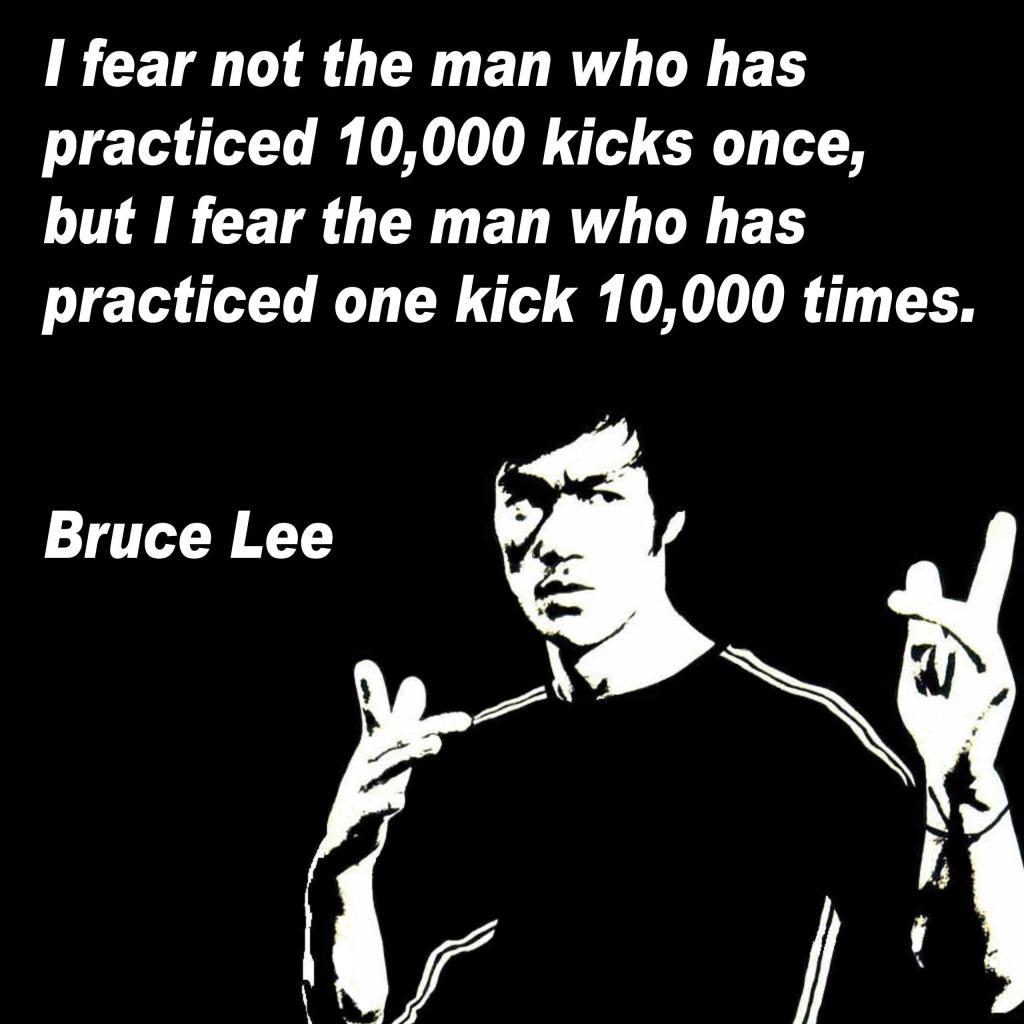
During those formative years, my personal training often involved making and breaking promises to myself and setting and abandoning intentions, creating a pattern of giving up or giving in. When a human being is challenged, it always falls back on its training. So, when life got hard, I fell back on mine, and either clung to things that should have been released or ran away from things that should have been held onto. Luckily, life presents a myriad of opportunities for overcoming every day, and we can choose to re-train.
When you want to create a new life pattern, it’s important to understand where the old one came from. Why are we doing things this way and not that way? How much is nature and how much is nurture? Looking at my own habits, some of them are personal, based in my particular family and genetic makeup, but others are widespread, societal things.
The root of societal laziness and fear seems to come from the avoidance of pain. We no longer ‘come of age.’ Most of us did not and do not have elders in our families or communities to teach us how to transition from childhood to adulthood, and so we just sort of…don’t. We stay in our hedonistic, adolescent larval stage, avoiding the cocoon of transformation because it doesn’t feel good.
***
In the Brazilian Amazon, the Satere’-Mawe’ tribe will search the humid, lowland rainforests for paraponera clavata, more commonly known around the world as the bullet ant. Locals refer to them as ‘hormiga veinticuatro’ or, in English, the ‘twenty-four-hour ant’, referencing the long-lasting pain induced by a single sting. The Satere’-Mawe’ call them ‘tucandeira’, meaning ‘that which wounds deeply.’
On the Schmidt Pain Index (a rating scale from 0 to 4, with zero being no pain at all, and 4 being excruciating), the bullet ant ranks as the only insect to rate beyond a 4. Schmidt himself, the entomologist who has endured countless bites and stings from various insects over the course of his career, described the sting of the bullet ant as “pure, intense, brilliant pain. Like walking over flaming charcoal with a three-inch nail embedded in your heel.” Their sting releases poneratoxin, a paralyzing neurotoxic peptide that interferes with nerve cells’ ability to send signals back and forth. This causes slow, long-lasting contractions of mammalian smooth muscles, cold sweats, nausea and vomiting, extreme pain, and arrhythmias of the heart.
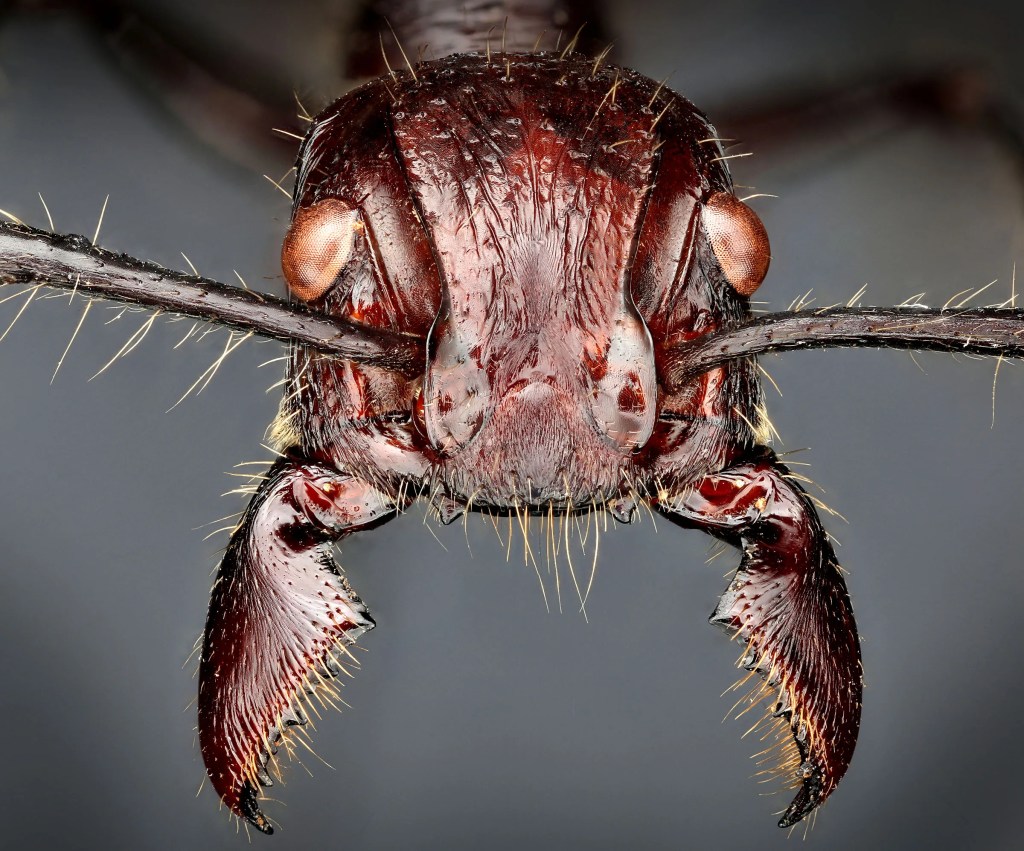
Bullet Ant, Image Provided By Adobe’s Macroscopic Solutions
Once collected, a Satere’-Mawe’ medicine man submerges the ants in a sedative of crushed cashew leaves before they are woven, stingers pointed inwards, into palm-frond mittens. There are, on average, 80 to 200 ants in each mitten pair, depending on the tribe and size of the mittens. Less than an hour later, the ants awaken angrier than ever, and the Bullet Ant Ceremony begins.
Boys as young as 12 will participate, lining up at a sort of bamboo bar, hands upraised in crab-claw poses, heads bowed. They must wear the gloves for more than ten minutes, submitting to the writhing insect host without crying aloud. They may sing or chant, but never scream in weakness. To help them meditate through the pain, the boys are led in a ceremonial dance, their arms linked to form a line, each one helping the other remain upright.
Once the gloves are removed, the pain only intensifies as the poneratoxin spreads. Initiates may take up to a week to fully recover, sometimes spasming for days. This agony symbolizes their readiness for manhood. The point is not to wall yourself off from pain, but to thoroughly understand it, accept it, and learn from it. Strength and stamina are required to survive in the jungle. “If you live your life without suffering anything, or without any kind of effort, it won’t be worth anything to you,” a Satere’-Mawe’ chief said. Each boy will wear the gloves 20 times over the course of several months before the initiation is complete.
Thanks to YouTube, the Bullet Ant Ceremony has become a major tourist attraction, drawing would-be macho men from around the world who pay to participate. They nervously crack jokes about the silliness of it all, or they roar like human bulls, trying to psych themselves up for the challenge. Some swagger and boast, and only a rare few quietly and respectfully engage to the best of their ability. They move into position with their borrowed headdresses and painted hands like children playing dress-up. Almost all of them fall rapidly apart with shrieks, swears, weeping, and wild flails. They are taken to the local hospital, shrilly demanding pain relievers.
The Satere-Mawe smile. Thank you, come again.

Bullet Ant Ceremony, Photographer Unknown
North Baffin Island in the territory of Nunavut is covered for most of the year in snow and ice. Because it is so close to the Arctic Circle, there are six annual weeks where the sun does not rise, and darkness reigns over the land. Great winds create blizzards that turn inland waterways into icy land masses. Years ago, the Inuit hunted seal and narwhal on these masses for meat, hides, and fat, which provided the extra calories needed to withstand the extreme cold. In June, birds returned to lay their eggs on the tundra floor, providing a welcome change in nourishment. In August, the Inuit followed the caribou who had travelled through on their annual migrations. Their meat was frozen and stored, and their hides provided new winter clothing, sewn and decorated by the women.
These days, the people are tired and disenchanted, disease and starvation having dwindled their numbers and spirits. They must make compromises between modern technology and old traditions. Igloos and animal skin tents have been replaced by government housing, and snowmobiles are favored over sleds. Noise from motorboats, snowmobiles, seismic testing, and rifles have frightened away much of the game, and the Inuit say that the trust between humans and animals has broken down.
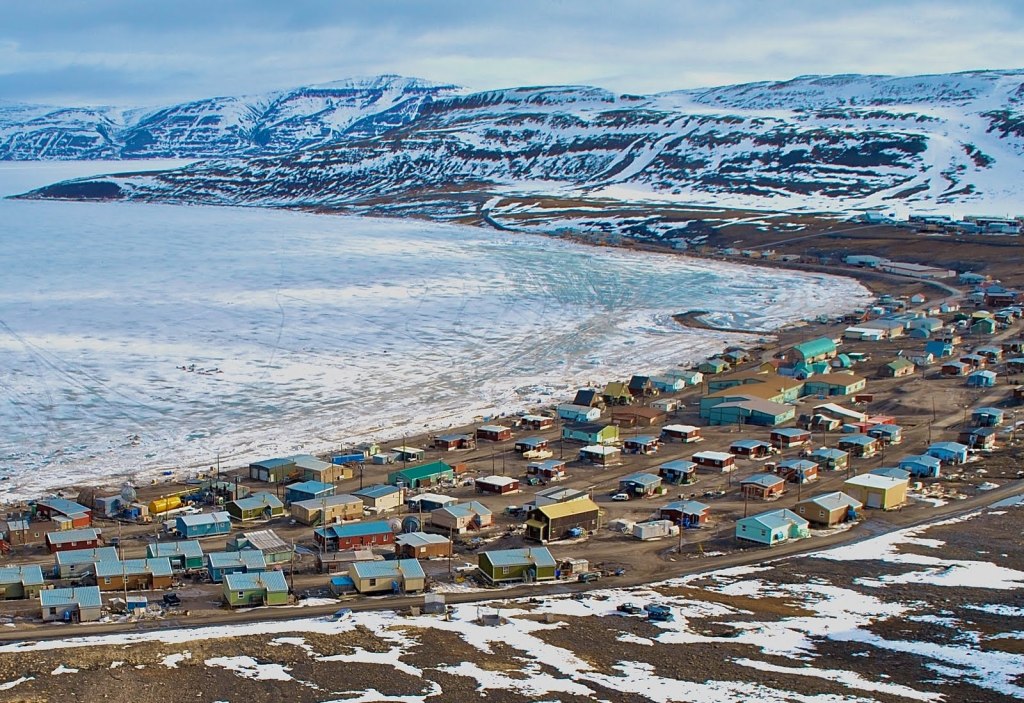
North Baffin Island, Photographer Unknown
Their shamans are rarely called upon to explain the world and its balances because young people no longer care for their ‘wisdom.’. Exposure to the internet hive mind and the harsh reality of their own existence has disenfranchised them with spirituality, their trust in religious leaders replaced by the words on their screens. Elders fear the loss of culture, tradition, and the strength needed to survive such a harsh landscape. They have begun to revive coming of age ceremonies. The shamans are being asked once more to open the lines of communication between man and animals before boys go out into the wilderness with their fathers or grandfathers. There they will practice and test their hunting skills as well as their resilience and adaptability.
Young women are engaging in a rite of passage in which they receive Tunniit, facial or thigh tattoos that signal a readiness for adult responsibility through the pain of transformation. To receive Tunniit, one must master difficult, essential skills, proving one’s value to the tribe and a future family. The design of the tattoo may differ for the individual based upon the community she is from, but each one represents some form of beauty attained through courage and endurance.
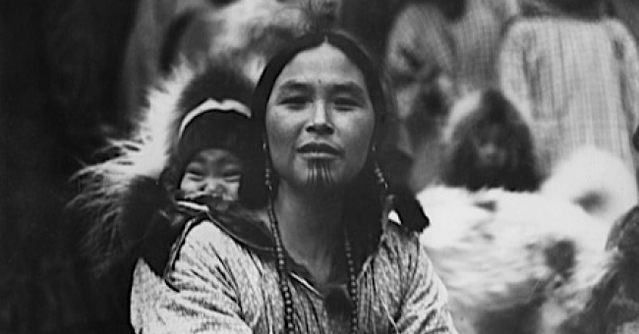
Tunniit, Photographer Unknown
In Vanuatu, a small island nation in the middle of the Pacific, young boys jump from a 98-foot tower with a bungee-like vine tied around their ankles. Unlike a bungee, however, the vine lacks elasticity, and the goal is to come as close as possible to brushing their heads on the ground without dashing them in. Boys begin jumping at the age of 7 or 8 from a smaller tower while their mothers hold an item representing their childhood. When the jump is completed, the item is thrown away, symbolizing the end of childhood and the beginning of facing one’s fears.
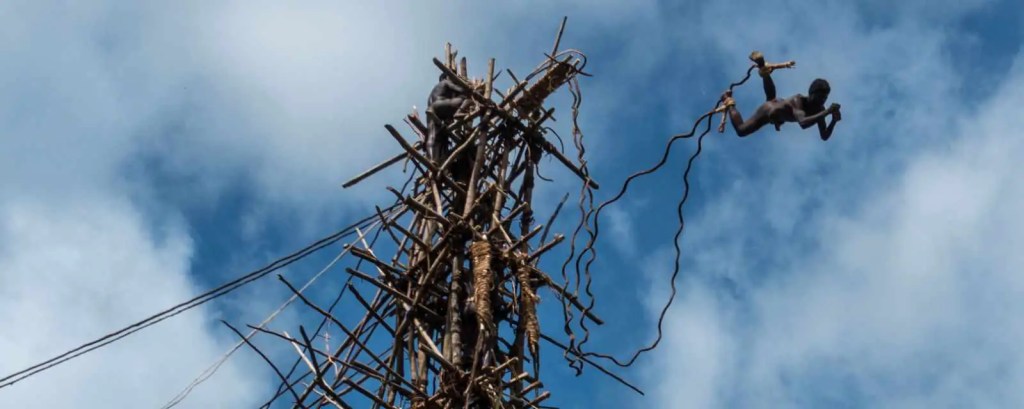
The Vanuatu Jump, Photographer Unknown
Apache girls participate in a Sunrise Ceremony or ‘Na’ii’ees’. These four days represent the baby, children, and teens they have been, and the women they will become. They run laps every day, memorize native plants and their uses (Apache women have always been healers), and dance for hours. On the fourth night of the ceremony, the girls will dance from dusk until dawn. Exhausted once the sun rises, they run laps once more, and on the fourth lap they run as far into the wilderness as they can before returning. Their families run with them, shouting encouragement to the staggering girls. The farther they go, the stronger they will be in life.

Na’ii’ees, Photographer Unknown
Aboriginal boys between the ages of 10 and 16 go on Walkabout, an excursion into the outback that lasts six months and hundreds, sometimes thousands of miles.

Walkabout, Image By Nicolas Roeg, 1971
The Mentawi tribe of Indonesia files the teeth of young girls aged 10 – 14 into points using nothing but a chisel and elbow grease.

Tooth Filing, Photographer Unknown
And on and on it goes. At least, for some. I come from the modern United States. Some of us are the YouTuber’s paying to shove ant mittens on our hands and squealing for a few likes, and some of us are truly exceptional. Most of us are the pain avoidant creatures I mentioned earlier who will pay any price to have our aches removed.
In 1974, the philosopher Ivan Illich published a book called “Medical Nemesis: The Expropriation of Health.” He wrote:
“When cosmopolitan…civilization colonizes any traditional culture, it transforms the experience of pain…People unlearn the acceptance of suffering as an inevitable part of their conscious coping with reality and learn to interpret every ache as an indicator of their need for padding or pampering. Traditional cultures confront pain, impairment, and death by interpreting them as challenges soliciting a response from the individual under stress; medical civilization turns them into demands made by individuals on the economy, into problems that can be managed or produced out of existence… Culture makes pain tolerable by interpreting its necessity; only pain perceived as curable is intolerable.”
“Patience, forbearance, courage, resignation, self-control, perseverance, and meekness each express a different coloring of the responses with which pain sensations were accepted, transformed into the experience of suffering, and endured. Duty, love, fascination, routines, prayer, and compassion were some of the means that enabled pain to be borne with dignity… Now an increasing portion of all pain is man-made, a side-effect of strategies for industrial expansion… It is a social curse, and to stop the “masses” from cursing society when they are pain-stricken, the industrial system delivers them… pain-killers… Pain has become a political issue which gives rise to a snowballing demand on the part of anesthesia consumers for artificially induced insensibility, unawareness, and even unconsciousness… Pain loses its referential character if it is dulled, and generates a meaningless, questionless residual horror… (It) turns people into unfeeling spectators of their own decaying selves.”
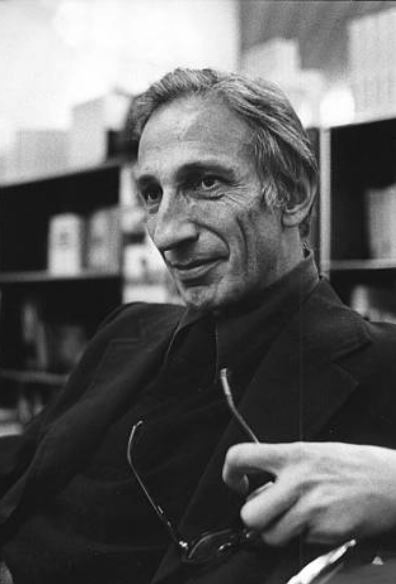
Ivan Illich
We are oh so cosmopolitan here in the U.S.A. Just like Jason Calhoun’s rats and mice from Chapter 1 in their ‘Utopias,’ we are slowly becoming ‘spectators’ as Ivan put it. We have succeeded in monetizing our pain and making our every ailment curable, both physical and otherwise. If it hurts, something is wrong. Medicate, rest, distract, escape. We pop ibuprofen (or something stronger) for our headaches, purchase office chairs with ever-increasing cushioning to support our atrophied bodies. We build ‘safe spaces’ in public areas and apply ‘trigger warnings’ to our thoughts. We handle one another and ourselves with kid gloves that smell of latex and antiseptic.
I work remotely, answering the phone for a housekeeping company, and I cannot begin to impart how often people experience discomfort and believe themselves to be sorely injured, ill, and unable to work simply because they have never before exerted themselves. They flee their job sites after experiencing an increased heart rate, rapid breathing, nausea, over-heating, and lightheadedness, certain they are coming down with the flu, covid, or having heart attacks at age twenty. One young woman called out because her arms were sore from running a vacuum the day before, and it was a new sensation for her. She had spent the entire night icing, heating, and rubbing various ointments and balms into her limbs, sobbing in a sort of sleepless delirium.
What each terrified housekeeper needed was to stop conditioning themselves into this delicate and fragile state by running from pain. They needed Yoda with his ‘There is no try, only do,’ but I must not say those words. Instead, my job description insists that I don the kid gloves Americans seem so fond of. “I’m sorry you’re not feeling well. Seek medical attention if needed. Please follow the appropriate channels to call off for the day and get some rest. Let me know if you need anything,” I gag out, appalled.

Yoda, Still From George Lucas’ The Empire Strikes Back
 ljfrantzich.com