
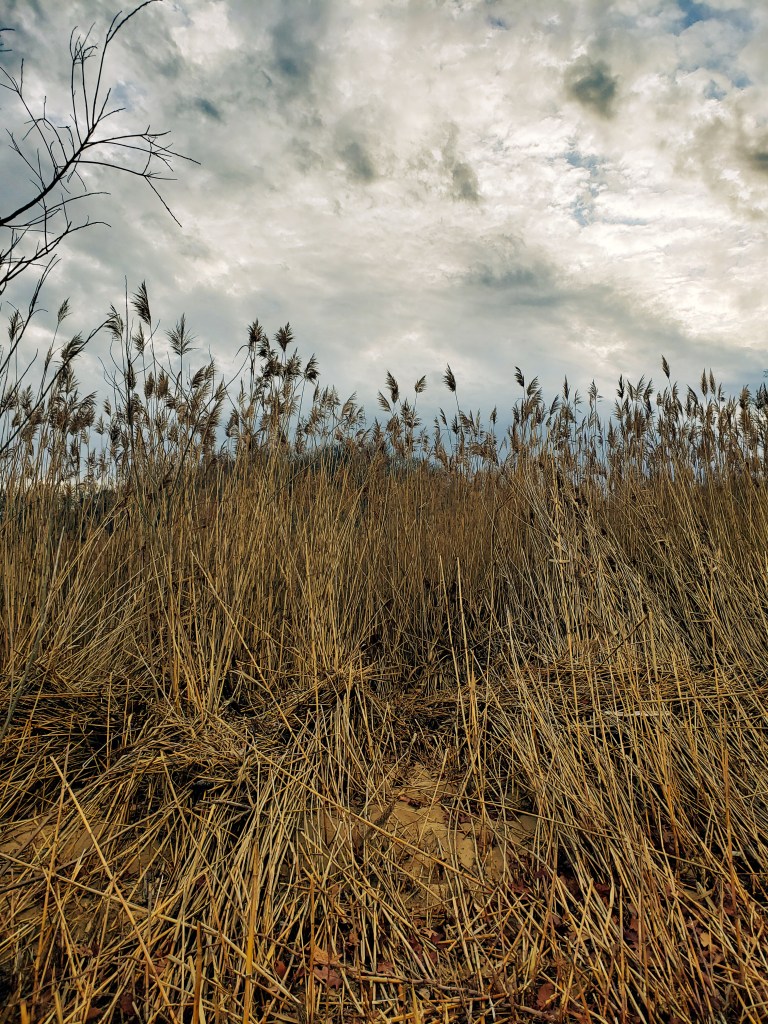
The summer air moves heavily, so thick I feel I could swallow and still find its flavor on my tongue hours later. It brushes like wet velvet through dense thickets of phragmites and sets them to a chaotic disharmony of thin and hollow rasping. The sound reminds me of crone’s hair, and I imagine the earth as a giant. I am standing on her knobby and misshapen head like a baby flea with lame legs. My exoskeleton is still soft and malleable, rendering me vulnerable while I creep through the course stalks, my feet sinking into scalp that is speckled brown and tan. The fleshy scales and dirty sebum masquerade as sand and mud, clinging to the soles of my feet.

Phragmites are an invasive species, conquering great swaths of land and claiming it all in a tightly woven reed bed. They displace native wetland inhabitants by a variety of means. They produce gallic acid, which triggers elevated levels of reactive oxygen species in susceptible plants. This disrupts and damages their root systems in a sort of cell-death cascade until they succumb to its phytotoxicity. Their above ground biomass is so large (stretching 6-15 feet in height and spreading up to 16 feet in width per year) that they blot out the sun, smothering smaller, weaker species in a pervasive darkness that belies their cheerful swaying and and soft, seed-head hats.
The only real way to eradicate phragmites is to burn them repeatedly over seasons, for their roots stretch so deeply and with such strength that a single burning hardly bothers them at all.
Phragmites seem unpleasantly symbolic of our nation’s history, and I suppose one could find many an unpleasant and sinister analogy. However, when I hear their eerie song, I am transported much farther. I picture the Mongols, the Scandinavian ‘vikings,’ and others before them, travelling to this wild land and saying, “You shall not conquer me. I shall stretch out my roots in your soil. I shall soak in your sun, defeat the strangle-vine you send against me, survive your brackish waters, and revel in your changing seasons. We are adventurers and voyagers. Our cries and our laughter shall resound over your plains and waters, echo in your deep valleys, and whisper about your mountaintops.”
The phragmite’s song evokes the thrum of ancient drums, gnarled fingers with yellowing nails that weave baskets and manipulate looms, lovers trysts, the exhilaration of men and women on horseback – each hoofbeat a prayer for more, and stories told beneath the Milky Way.
I listen, I listen, I listen.
There is another sound. A sound I can both hear and not hear. I feel as though my rib-cage should rattle with the sound, and yet it is still. It is the sound of sap blood moving in vein-like roots, of currents too deep to swim, of stones forming, of stale, clay-cave air never before breathed by man. It is a song that longs to be sung, a wild child’s cry, exuberant and too long contained. It is a song that tears at my insides, because I long to sing it too, and do not know how. Something within me has forgotten the words.
It is a smothered chorus, and I cannot find the fingers that wind their way across and into my mouth. At times, I feel that I am caged with all the world in a sinister, forgetful cloud. It pushes in past clenched teeth, slithering down our throats to drown our souls.
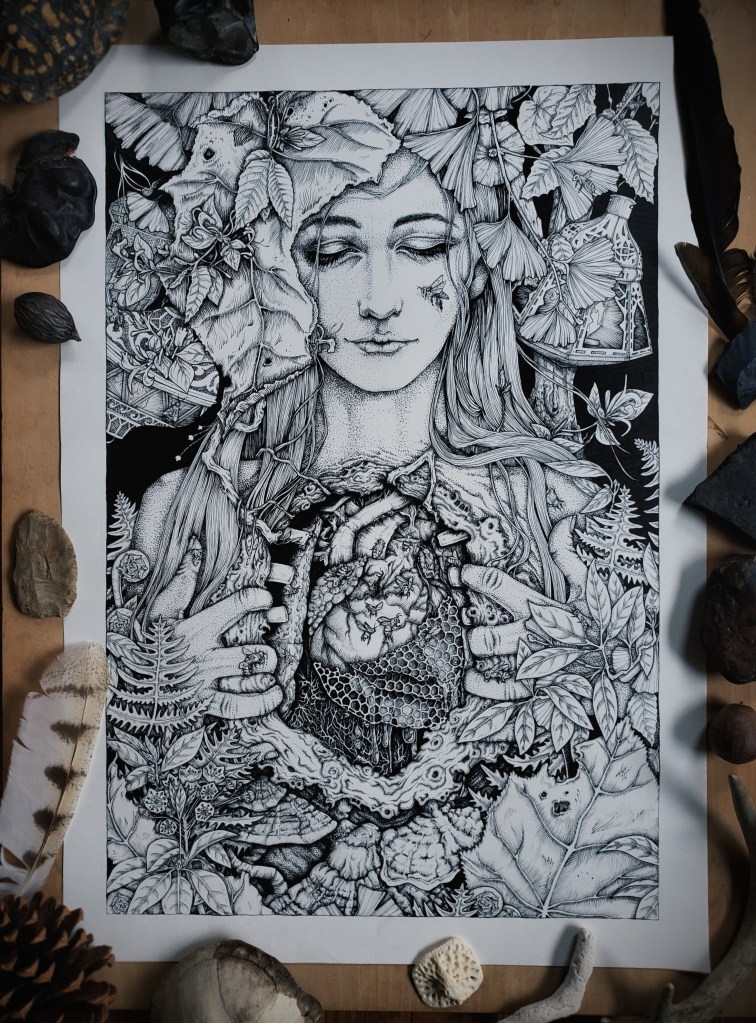
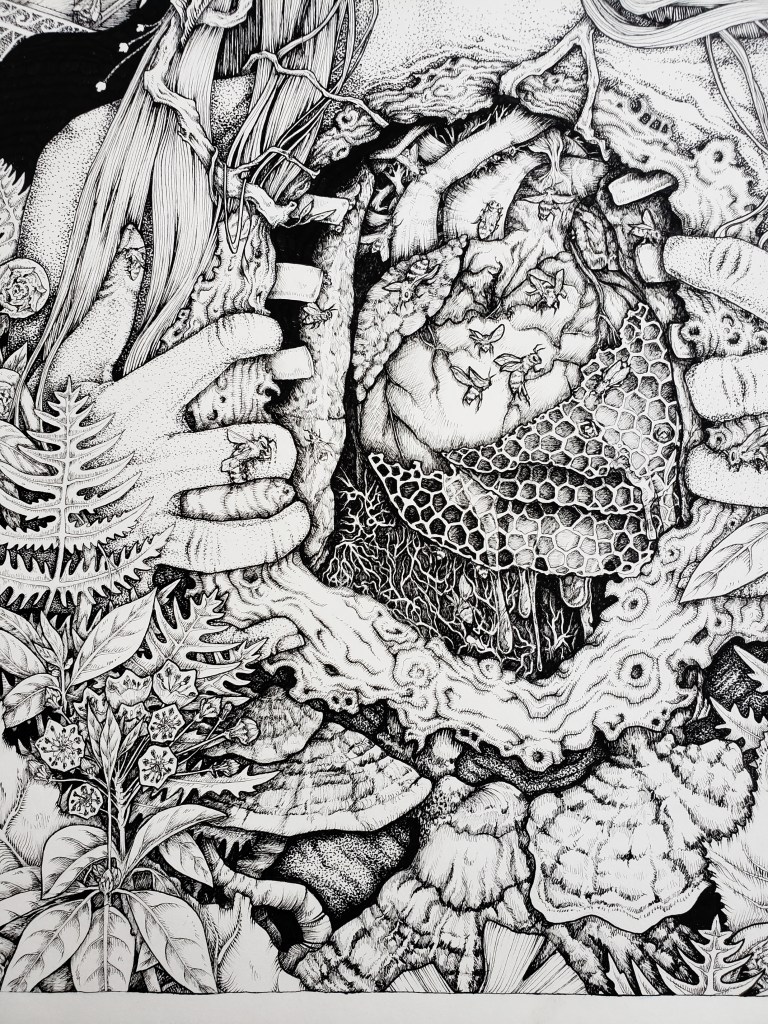
I want to claw open my chest , find my heart, and lift it to the sky, letting it breathe. I want to dig a hole in the wet earth and bury my heart, letting it soak in the healing, crone-scalp soil. I want to offer it to the birds so they can carry away pieces of me in their beaks like dark, shining pomegranate seeds, each one travelling farther than the last and learning to fly.
I want to call the waves, to ride the wind, to coax ferns to unfurl, to learn the language of beasts, and to run along mountain paths where stone and shale respond to the cry of my bare feet.

I listen, I listen, I listen.
I ache. I am inspired. I am small. I am not alone.

 ljfrantzich.com